Open-source Vs Closed-source AI: Making A Choice
Torn between open-source and closed-source artificial intelligence? Not sure which way or tool to choose? Here is everything you need to know.

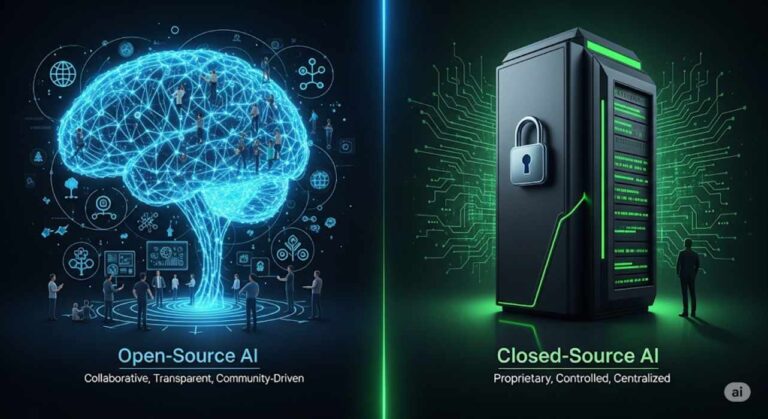
If you are a developer or planning to employ AI tools in business, then you will sooner or later have to decide between using open-source and closed-source AI software.
As with most other types of software, open-source AI tools are often free and require you to have a certain level of technical competence, while the closed-source alternatives often require payments to use them.
This article compares these two sectors of the artificial intelligence industry in a bid to provide all the information that you need to make an informed business or project-development decision.
What Are Open & Closed-Source AI?
Open-source and closed-source AI generally refer to artificial intelligence software tools, which fall under two categories. The first category is those whose source code is open or available to the public, and hence their name “open-source”. The second is the closed-source, whose source code is not available.
- Open Source: Being open-source means that anyone can download, read, and execute the project’s source code. A source code is the written set of instructions for any computer program that can be run on a computer at any time to execute that program. While many or most open-source software tends to be freeware, some are proprietary systems that you still need to pay for.
- Closed Source: This category of software is more like black-box systems; you can use them, but you can’t figure out how they work. They are usually promoted by for-profit corporations, and while they cost money to use, they are often backed by a technical support service or something similar.
For most users, AI refers to large-language models such as ChatGPT, Deepseek, and Gemini. However, it is noteworthy that several AI software tools such as TensorFlow are equally categorized into open-source and closed-source AI software. Therefore, we can differentiate between open- and closed-source AI models and open- and closed-source AI tools, in general.
Money Makes The World Go Round
Software development can be expensive, and this is why developers often monetize their products to earn money and be able to support their ongoing development work. Developing large-language AI models, however, is even much more expensive than developing everyday software.
First, you need to house the model in a large data center. Then you need lots of talented engineers to create your system and others to collect extensive amounts of data from all over the Internet, then to clean and prepare them for feeding into the model, called training. Then there is energy use costs and fine-tuning of the model, which is simply more training.
In the end, while a single developer can spend their free time after work each day to develop a game, a dating website, or a file manager and publish it for free, it takes a small to medium group of experts to develop an AI large language model. Talent and infrastructure cost money, and that’s why it is such a big issue with AI models, with major players having to choose either the open-source or closed-source approach.
Pros & Cons of Open-source AI
Open-source artificial intelligence systems have their pros and cons, and these can be helpful or a hindrance, depending on what you hope to achieve with the software. The major pros and cons are as follows:
Pros of Open-source AI
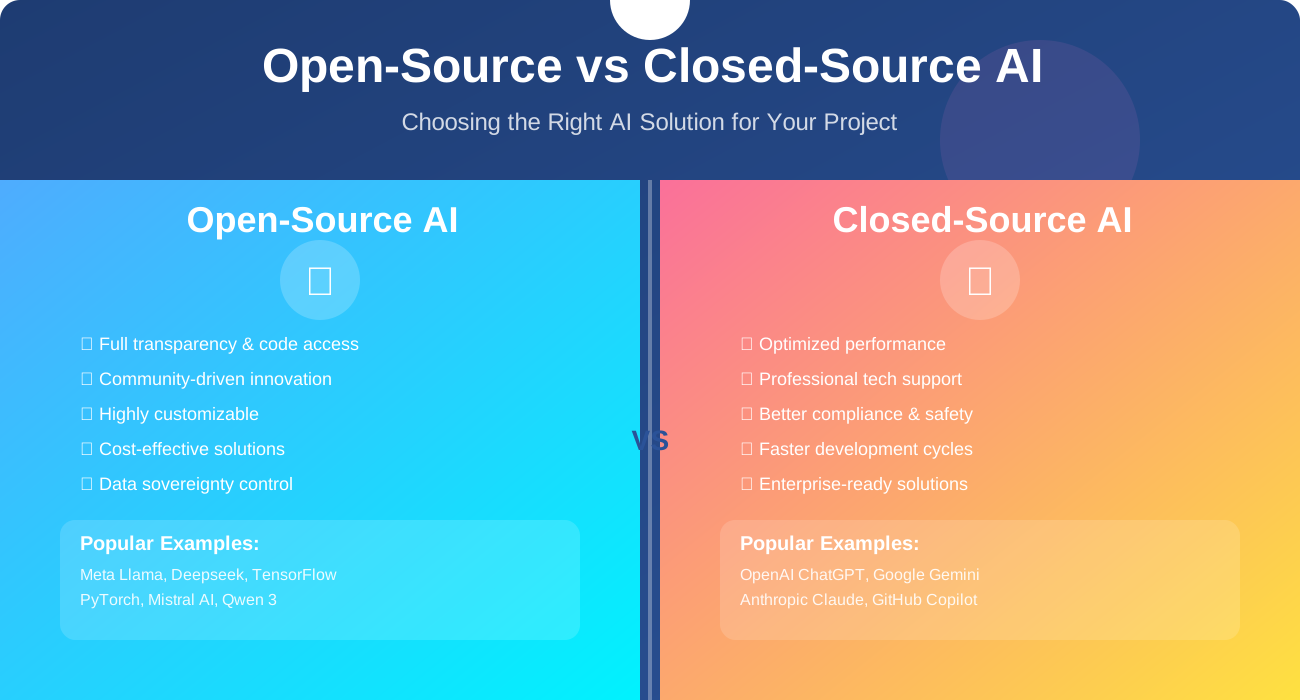
- Transparency & Better Code Scrutiny: Open-source projects are more transparent because everyone can download the latest versions and see for themselves what exactly is going on. Unlike their closed-source counterparts, individual developers and groups can scrutinize the code to find flaws or contribute patches and improvements. This is the major reason why open-source projects like WordPress are impressive.
- Innovation & Standardization: Individual coders and teams can innovate on their own and submit their final work for inclusion in the open-source code. This keeps the project up to date. Plus, so many different people working together leads to the standardization of procedures, protocols, and various technologies. This, in turn, creates standardized software that most people can work with, unlike the vendor-specific technologies that proprietary systems often utilize.
- Community & Collaboration: Most open-source projects have online communities where contributors and users come together to collaborate. People exchange ideas and innovate freely in such environments, leading to a warm community that you don’t get with closed-source systems.
- Customizability: Every developer can take their copy of an open-source software and customize it exactly the way they want it to run. This is much better than adapting to a closed-source system’s uncomfortable design or working procedures, especially when all that was needed to make it okay was just a minor tweak.
- Cost Efficiency: With an absence of licensing fees, open-source systems make it possible for developers to create amazing projects that would otherwise have been impossible. WordPress, for instance, was built on the open-source PHP language and went on to become a platform for countless other projects. Open-source will likely create a similar boom in the artificial intelligence industry in the future.
- Data Sovereignty: Finally, those working with sensitive data are better off with open-source AI systems because they offer them sovereignty over their data, to do with as they please. The alternative to working with a closed-source system is that you can’t guarantee what will happen to your data, especially when said system is hosted off-premise. Open-source software hosted on-premise remains the best solution for sensitive data.
Cons of Open-source AI
- Technical requirements for the user: Most open-source software is offered “as is”. This means that if you don’t get it or can’t make sense of it, then you are on your own. This is especially true with open-source software aimed at tech people.
- Lack of tech support: The same reason as the above. There is hardly any dedicated tech support for open-source systems. Most of the technically competent users fish out solutions for any problems by themselves, either through search engines or by scouring online forums.
Pros & Cons of Closed-source AI
Closed-source artificial intelligence systems also have their pros and cons, and they can be helpful or a hindrance, depending on what you hope to achieve with the software. They are as follows.
Pros of Closed-source AI
- High performance: Closed-source systems generally perform better than open-source software systems because they are optimized and often come with recommended hardware or accompanying systems. Of course, open-source systems can be optimized to be as high-performance as their closed-source counterparts, but that usually requires a skilled user. Closed-source systems generally perform better straight out of the box than their open-source counterparts.
- Centralized control & faster development: Given that closed-source AI systems are developed by a centralized team with a unified focus, they can develop required features much more quickly and efficiently than the open-source camp, which often requires a volunteer to add a useful feature to the base code, before it is generally accepted.
- Better compliance: Closed-source AI systems are also more compliant with rules and regulations than their open-source counterparts. The company behind a closed-source AI chat model, for instance, makes sure that its model stays within the accepted boundaries of social interaction and free speech. An open-source system, on the other hand, cannot guarantee such compliance, no matter how much the original developers of the code try to enforce it. Anyone using open-source code to create an AI chatbot can literally do whatever they want with it.
- Often includes tech support: Customer support is another area where closed-source systems beat open-source. If you are a paying customer for an AI system or most other software, for that matter, you expect to get some customer support whenever you have issues with the software. This is especially true when it is a technical issue. Open-source and most free services, on the other hand, are usually offered “as is”, without customer or tech support. Many open-source communities, however, offer forums where users can exchange ideas with each other.
Cons of Closed-source AI
- Higher user costs: Since most closed-source systems, including AI services, are proprietary, you generally pay to use them. Some services like ChatGPT, for instance, are offered through a Freemium model, which allows free users some limited use, while paying customers can do much more or get priority access.
- Biased models: Closed-source AI models are also more prone to bias from their developers. For instance, most users of LLM chatbots assume all the responses they are getting are 100% from the AI, without stopping to think that these bots are tuned to produce certain responses, while avoiding others.
Making A Choice
Knowing what closed-source and open-source AI systems are all about, you or your team may find yourselves forced to choose between the two. As you can understand, this is no small task because you have to take so many issues into consideration. Here are three perspectives to look at the situation from, which may help you reach a faster decision:
- Individual Developer: If you are an individual developer looking to get your feet wet in the world of artificial intelligence, then it’s best that you try out both open-source and closed-source systems to help you maximize your learning. You can always try out free versions of proprietary systems if you are on a budget.
- Startup: If you are a startup and especially in the tech field, then you should seriously consider open-source systems because they offer you the opportunity to build something that you can put your name on.
- Commercial Entity: For all other groups and businesses looking to maximize income from their respective markets, closed-source is the way to go to save time and avoid delays. The only exception here is if you have a competent tech department or developer who can guarantee you results with open-source.
List of Open-Source AI Projects
List of Closed-Source AI Projects
Frequently Asked Questions
Here are some frequently asked questions regarding open-source and closed-source AI software.
Q: Can I download and run my own open-source AI model?
A: Yes, there are hundreds of free and open-source AI models you can download and test. Check out https://aimodels.org/ai-models/
Q: Is open-source software always free?
A: No, not always. Most open-source software are free, but not all. There are many commercial products that are open-source. Many are only free for personal use and you have to pay for commercial use.
Q: Can I sell open-source software?
A: It is generally not allowed, unless you are packaging it with a larger commercial software, in which case you may have to implement a dual-licensing model for your product.
Q: Is OpenAI an open-source company?
A: No, OpenAI does not offer open-source AI models. It started out as an open-source company though, but its leaders allegedly succumbed to the pressures of capitalism.
Q: Which is more trustworthy, an open-source or closed-source AI model?
A: An open-source model is more trustworthy. Open-source software are always more trustworthy.
Conclusion
We have explored open-source and closed-source systems in artificial intelligence development and you have seen the best options for different needs. In the end, both open-source and closed-source AI tools have their advantages and disadvantages. The best option for you therefore, will depend on your software needs.
Related Articles